
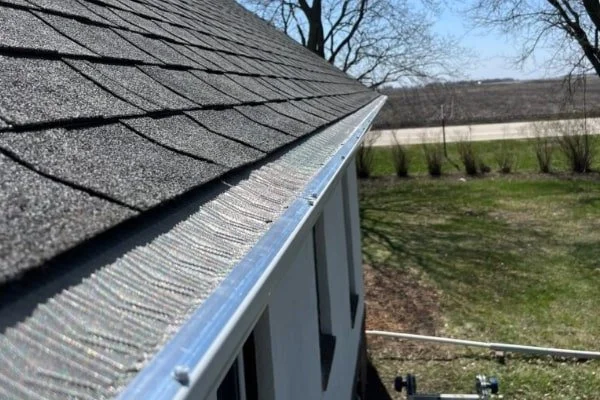
Protect Your Home with Leak-Free Gutters Designed to Last
Seamless Gutter Installation and Repair in St. Cloud, MN
St. Cloud has more homes built before 1950 than any other city in this service area, and those homes have been through a lot of Minnesota winters. Original or early-replacement gutter systems on houses from that era have been carrying 65 to 70 freeze-thaw cycles a year for decades. Go Getter Gutters installs, repairs, and replaces seamless gutters in St. Cloud, MN, across the older established neighborhoods and the newer developments that have grown up around them.
What St. Cloud Puts Your Gutters Through
St. Cloud gets about 29 inches of rain a year, with the heaviest events concentrated in spring and early summer. Snowfall runs around 48 inches most winters, melting gradually through late winter and early spring in a slow, sustained drip load that works on gutter joints over months. The last spring frost here typically holds until late May, and the first fall frost arrives by late September, which means the window between freezing seasons is shorter than in most of the surrounding area.
Through a typical St. Cloud winter, temperatures cross the freezing mark roughly 65 to 70 times in both directions. That is among the highest freeze-thaw cycle counts in Minnesota, and it is the core mechanical argument for seamless gutters in this city. Every joint in a sectional system is a point where water infiltrates, freezes, expands, and widens the gap. Over decades of cycling at that rate, original sectional gutter systems on older St. Cloud homes are not wearing out. They have worn out. Seamless gutters are fabricated on site, cut to exact length at the house from a continuous run of material. No joints along the run means no place for that failure to accumulate.
What's Getting Into Your Gutters
St. Cloud's tree canopy reflects the age and scale of the city. Silver maple and green ash have been boulevard trees here for generations, bur oak is throughout the established neighborhoods, and cottonwood lines the Mississippi River corridor that runs through the city. That combination produces debris across nearly every point in the season.
Silver maple helicopter season runs from late April into June. On properties where the trees have been growing for 40, 50, or 60 years, the samara drop during peak weeks is substantial enough to pack a gutter run completely. Fall brings heavy maple and oak leaf drop that often continues well past the first freeze, and the tannin in oak leaves works on aluminum over time on properties where oak is the dominant tree.
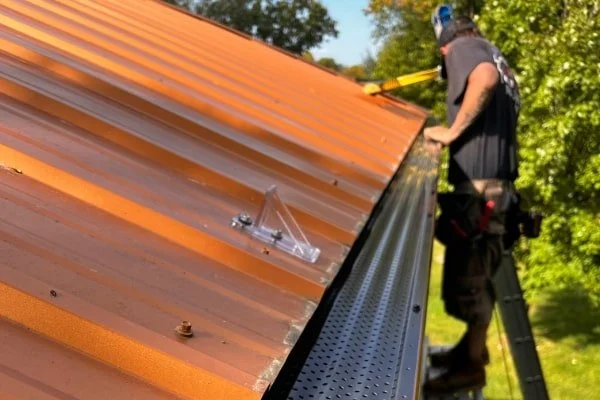
Cottonwood season along the Mississippi hits in late May or early June in a concentrated burst that lasts about a week. The seeds are light, travel on any breeze, and pack gutters faster than almost any other debris type. For properties near the river or downwind of cottonwood stands, this is not a gradual seasonal accumulation but a single rapid event that requires attention.
The ash trees throughout St. Cloud are in various stages of decline from emerald ash borer, and St. Cloud's established boulevards carried significant ash planting over the decades. Dead and dying trees are shedding bark chunks and debris through the season at rates a healthy tree never produces. Properties with ash on the boulevard or in the yard are carrying significantly more irregular debris than they were a few years ago.
For St. Cloud properties near the Mississippi with cottonwood, micro-mesh is the only guard that stops cottony seeds reliably. The Leaf Blaster Pro handles the cottonwood load and the maple seed volume together. Where oak is the dominant tree, the Bulldog guard handles the larger leaf debris well. The full product breakdown is on the gutter guards page.
What Happens When Gutters Fail Here
St. Cloud sits on Lester and Hayden series clay-loam glacial till, slow-draining soil where overflow from a failing gutter pools at the foundation and stays there. In clay soil, sustained saturation against a foundation wall builds hydrostatic pressure over time, and that pressure is the actual cause of basement water intrusion and foundation cracking. On a home that has been standing since the 1930s or 1940s, the cumulative effect of decades of gutter overflow on the foundation is not a future risk. It is a present condition on many properties.
St. Cloud has the oldest housing profile in this service area. A meaningful share of homes predate 1940, with another significant portion built through the 1940s and 1950s. Houses built before 1980 typically came with 4-inch sectional gutters, undersized by current standards and now carrying decades of freeze-thaw cycling at every joint. On homes from the pre-war and postwar eras, original gutter systems are well past the point where repair makes more sense than replacement. The fascia damage and foundation wear on a home with original gutters from that era is almost always more extensive than it appears from the ground.
Your St. Cloud Gutter Company
Go Getter Gutters is a small, owner-led operation. Not a franchise dispatching whoever is available that day across a wide territory. The same people show up on every job, and the work is held to the same standard on a century-old home in an established neighborhood as on a newer build on the edge of the city.
Before any work starts, there's a walkthrough. Garden beds near the foundation, a downspout location that matters to how water drains across the property, anything the crew should know before the ladders go up. That conversation happens first.
The installation details that determine how long a gutter system holds up aren't visible once the job is done. Geocel 2320 tripolymer caulk at every joint, a 50-year material. Hangers set every two feet instead of three, which keeps runs straight through years of freeze-thaw loading. Downspout straps fastened with four screws each. Elbow connections screwed, not pressed together. The drip edge peeled back, the gutter seated correctly, the drip edge screwed back down tight. None of it shows from the street, but it's what separates a system that holds up for 20 years from one that starts failing at the joints well before that.
Every job carries a lifetime labor warranty. The estimate is free, written, and in your hands before anyone leaves the property.
Schedule Your Free Estimate in St. Cloud
Go Getter Gutters serves St. Cloud and the surrounding area, including Sartell, Sauk Rapids, Waite Park, and St. Joseph. Call (320) 292-1907 to get on the schedule. We come out, measure the runs, and leave you with a written quote before we go, no estimate fee, no follow-up pressure.